A Fascinating Genetic Discovery: A Link Between China and Tunisia Over 3,000 Years Ago
When Genetics Traces Forgotten Paths of Human History
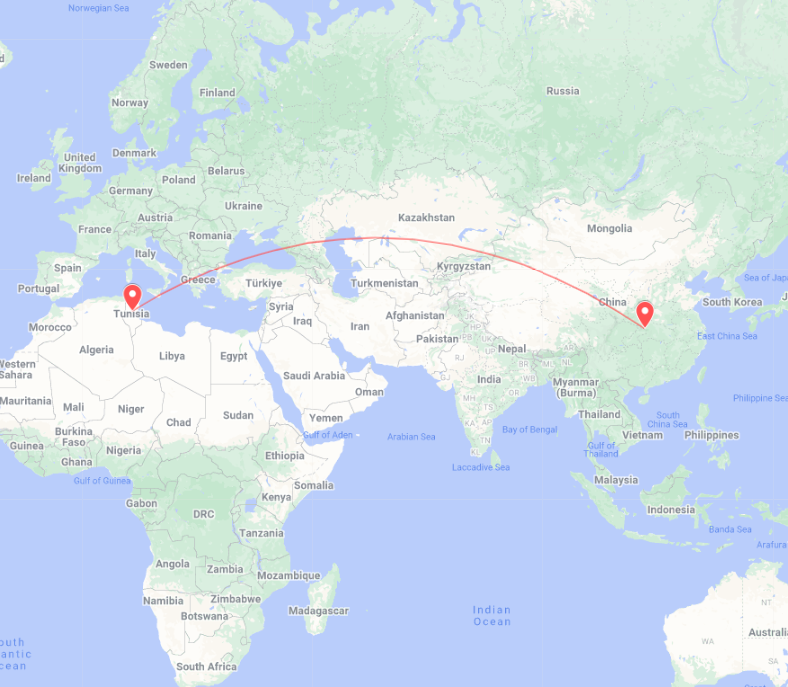
A recent study entitled “A pangenome reference of 36 Chinese populations”, conducted by the prestigious State Key Laboratory of Genetic Engineering at Fudan University in Shanghai, has revealed an unexpected discovery: an ancient genetic connection between a Muslim population in western China, the Salar, and the population of the city of Msaken in Tunisia.
Who Are the Salar?
The Salar are a Muslim Turkic-speaking ethnic minority living primarily in the province of Qinghai, China, especially in the Xunhua Salar Autonomous County. Their history spans several centuries, and they are often considered descendants of peoples from Central Asia.
Sample HIFI032453D: A Shared Genetic Signature with Msaken
Among the many samples analyzed in the study, one stood out: sample HIFI032453D, identified as belonging to a Salar individual from the Xunhua Salar Autonomous County.
Analysis of his Y chromosome (passed from father to son) revealed that he shares over 20 SNP mutations with individuals from Msaken, a town in central-eastern Tunisia. These shared genetic markers contributed to the update of the phylogenetic tree (ytree) of haplogroup J-L192, to which the Msaken population belongs.
A Common Paternal Ancestor Over 3,000 Years Ago
This genetic convergence suggests that the men of Msaken and some members of the Salar people share a common paternal ancestor who lived around 1000 BCE, during the Iron Age, long before the rise of classical civilizations.
Interwoven Human History
This discovery illustrates how deeply connected human populations can be across time and space. It highlights the richness of ancient migrations and the power of modern genetics to shed light on our shared human history.
Tracing Forgotten Roots: From Msaken to Samarkand, A Path Through Iran and Central Asia
When DNA Aligns with the Stories of Peoples
The recent discovery of a genetic link between a Salar individual from China and residents of Msaken, Tunisia, raises intriguing questions. How could a shared ancestor unite two populations separated by more than 6,000 kilometers? To understand this, we must turn to both oral traditions and the advances of genetic science.
The Salar People and Their Origins According to Tradition
Today, the Salar live in the Qinghai region. According to their own tradition and Chinese chronicles, they are descendants of the Salur tribe, one of the branches of the Oghuz Turks of the Western Turkic Khaganate.
Their ancestors are said to have left Samarkand (in present-day Uzbekistan) and migrated to China during the Tang dynasty. Over time, they settled in the border region of Gansu and Qinghai and developed their unique culture and language through interaction with neighboring peoples.
And on the Tunisian Side?
The Y-DNA haplogroup J-L192, common among the population of Msaken, was also found in this Salar individual. Even more intriguing, the closest genetic populations to Msaken outside Tunisia are groups largely composed of Zaza and Kurdish individuals.
The Zazas are known to have originated in the region of Daylam (Deylam), located in northwestern Iran near the Caspian Sea — a mountainous area that played a key role in ancient migrations.
A Common Origin Between Iran and Central Asia?
All the clues point toward a shared geographic origin located somewhere between northwestern Iran and Central Asia, in a zone stretching from Daylam to Samarkand. This region has long been a crossroads of civilizations, especially along the Silk Road and during Turkic and Persian expansions.
A Story Written in Blood
Although the Salars and the people of Msaken no longer share cultural ties, their genetic heritage bears witness to an ancient paternal lineage passed down over millennia. Thanks to science, this silent legacy is now brought back to life.
At the intersection of genetics, history, and oral tradition, this discovery reminds us that humanity is woven together by invisible threads — often rediscovered in the most unexpected places.